Think about all the things that hold a society together and never show up in any economic figure. The neighbour who checks on the elderly man two doors down. The colleague who quietly mentors the new hire. The stranger who notices you are lost and walks you to the right platform. None of it registers in the numbers we use to measure how well a country is doing. As far as the official scoreboard is concerned, kindness is invisible.
Now imagine it stops being invisible. Imagine a future where the glue that holds everything together is finally counted, valued, and rewarded, rather than silently relied upon and quietly used up.
The Things We Measure Become the Things We Get
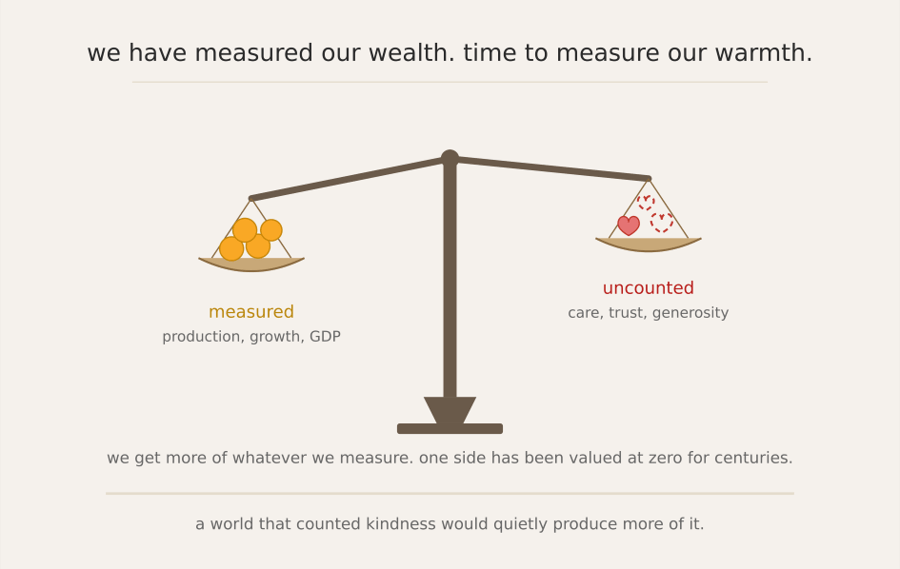
There is an old and slightly uncomfortable truth in economics: we tend to get more of whatever we measure and reward, and less of whatever we ignore. We have built spectacularly detailed measures of production, consumption, and growth, and we have built almost nothing to capture care, generosity, and trust. So we have optimized relentlessly for the first set and left the second to fend for itself.
The results are visible everywhere. The work of caring for people, for children, for the old, for the sick, is some of the most important work a society does, and it is consistently among the least rewarded. It is treated as a calling, which is a polite way of saying it is treated as something you should be willing to do for very little. We have built an economy that runs on kindness while refusing to put it on the books.
What Counting It Might Look Like
The optimistic future does not turn kindness into a transaction, with everyone tallying their good deeds for points. That would poison the very thing it tried to grow. The shift is subtler and happens mostly at the level of systems, not individuals.
It looks like properly valuing care work, paying the people who do it as if it were the skilled, demanding, essential work it actually is. It looks like organizations measuring whether they leave people better than they found them, and being judged on it. It looks like communities tracking their own health not only by income but by how connected and supported their people feel, and treating a decline in that as seriously as a decline in jobs.
Some of this is already stirring. There is growing interest in measures of national wellbeing that sit alongside the purely economic ones, attempts to ask not just how much a country produces but how its people are actually doing. These efforts are early and imperfect. But the mere fact that we are trying to measure the previously unmeasured is the first move in valuing it.
The Hidden Economy We Already Depend On
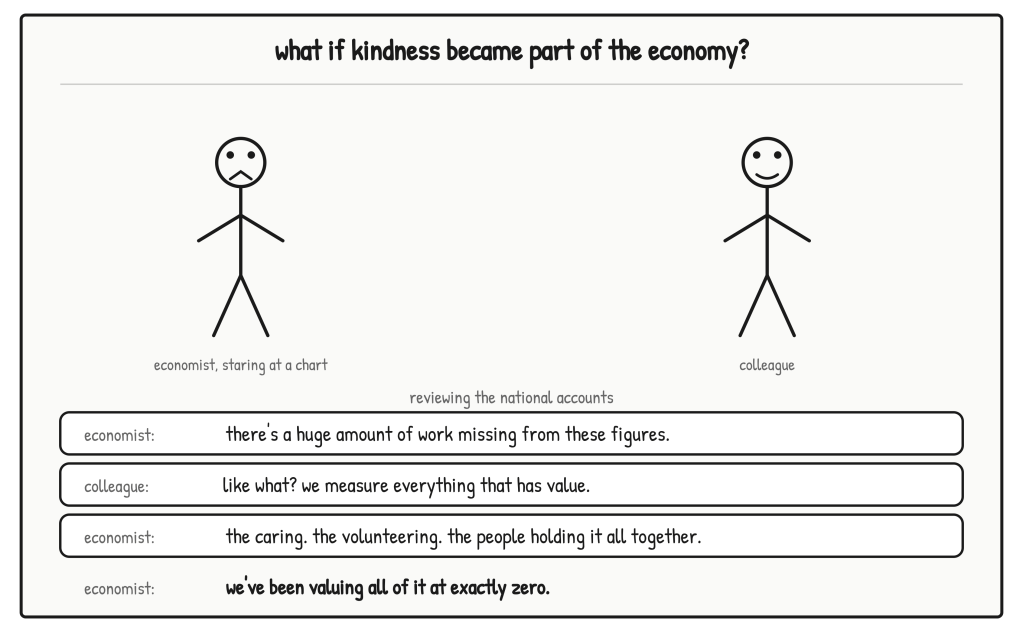
Here is what makes this hopeful rather than naive. The kindness economy is not something we have to build from scratch. It already exists, vast and humming, doing enormous quantities of essential work entirely off the books. The care, the volunteering, the small daily generosities: economists have tried to estimate their value and the figures are staggering, easily rivalling the formal economy we obsess over.
We are not proposing to invent kindness. We are proposing to stop pretending it is free. To acknowledge that it is produced by real people spending real time and energy, and that a society which uses it up faster than it replenishes it is quietly running down its most important reserve.
Why It Might Make Everything Else Work Better
The lovely thing about valuing kindness is that it is not a trade off against prosperity. It tends to produce it. Trust is the cheapest lubricant any economy has. Where people trust each other, business is faster, cheaper, and less defended by armies of lawyers and locks. Where communities are connected, people are healthier, which costs the health system less. Where care work is valued, the people doing it stay and get good at it, instead of burning out and leaving.
A kinder society is not a softer, less serious one. It is frequently a more efficient one, because so much of what we spend money on is really just the cost of repairing the damage that a low trust, low care society inflicts on itself.
The Honest Difficulty
The hard part is measurement without corruption. The moment you reward something, people start gaming the metric rather than serving the goal, and kindness is especially easy to fake. A future that gets this wrong could produce a grim theatre of performed generosity, all visible gesture and no actual warmth.
So the design has to be careful. It has to reward outcomes rather than performances, the genuine wellbeing of real people rather than the appearance of caring. This is difficult. It is not impossible, and the difficulty is no reason to keep valuing kindness at exactly zero, which is roughly where we have it now.
The Future Worth Choosing
The most optimistic futures are often not the flashiest. They are not flying cars or cities on Mars. Sometimes the best future is simply one where we finally start valuing the things that quietly kept us alive all along. A world that counted kindness would be a world that produced more of it. And a world with more kindness in it is, by almost any measure that actually matters to a human being, a world worth working toward. We have spent centuries measuring our wealth. It might be time to start measuring our warmth.
 What if in the Future
Leave a comment