The five-day week feels like a law of nature. It is not. It is an invention, roughly a century old, and like most inventions it was a compromise between what was technically possible and what the people of the time could imagine. For most of the twentieth century the working week got steadily shorter, and then, somewhere around the 1980s, it simply stopped. We have been treating an arbitrary pause as a permanent ceiling ever since.
Now imagine the shrinking starts again. Four days. Then, in time, perhaps fewer. And here is the part that sounds impossible: pay stays the same, output holds, and the economy does not fall over.
The Productivity Puzzle Nobody Talks About
The instinct is that less time at work must mean less work done. But the relationship between hours and output is far stranger than that. A great deal of the modern working week is not productive at all. It is presence. It is the meeting that should have been a message, the hour looking busy because the culture rewards looking busy, the slow afternoon drift where attention has already left the building but the body is contractually required to stay.
When trials of the four day week have been run, a consistent and slightly funny thing keeps happening. Given less time, people quietly delete the waste. Meetings shrink. Distractions get pruned. The work that actually matters gets done in the hours that remain, and the hours that were only ever theatre simply vanish. Output frequently holds steady, and sometimes rises, because rested people make fewer mistakes and better decisions.
Where the Extra Day Goes
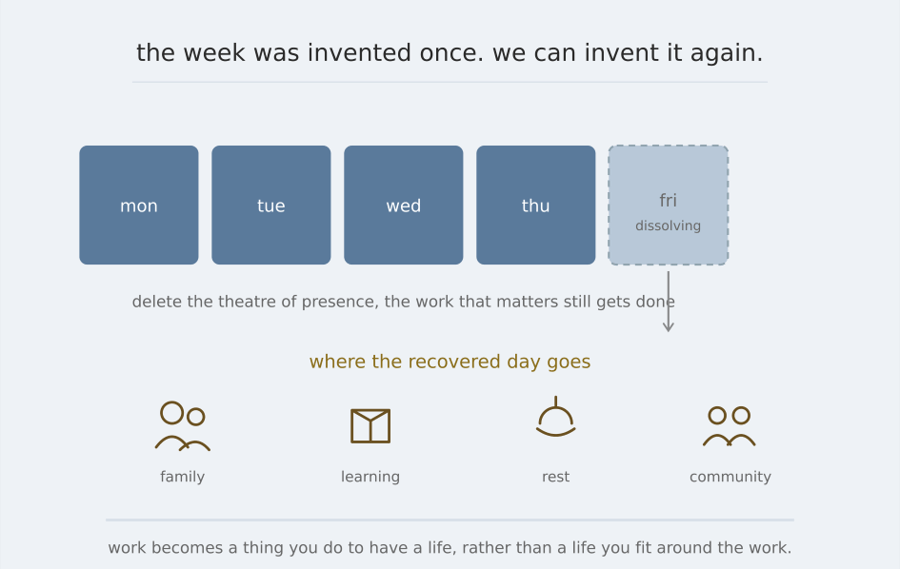
The optimistic future is not really about working less. It is about what the recovered time becomes. A third day away from work is not just a longer weekend. It is time to be a present parent rather than an exhausted one. Time to care for an ageing relative without it becoming a crisis. Time to learn something with no economic purpose whatsoever, which is one of the purest pleasures a person can have. Time for the community work, the volunteering, the small acts of neighborliness that a tired society stops having the energy for. A rested population is a more generous one, almost as a side effect.
The Health Dividend
There is a quieter benefit hiding here, and it shows up in the body. Chronic overwork is not a badge of honor; it is a slow tax on health. It feeds the stress that feeds heart disease, the sleeplessness that feeds everything else, the burnout that empties people out long before they retire. A shorter week is, among other things, a public health intervention that happens to also be pleasant.
A society that worked a little less might spend a little less keeping itself patched up. The savings would not show on any single pay slip, but they would be real, distributed across millions of slightly healthier lives.
The Objection, Handled Honestly
The fair challenge is that not all work compresses neatly. A nurse cannot care for a patient in fewer hours by deleting a meeting. A bus must still be driven the whole route. For a great deal of essential work, fewer hours genuinely means you need more people, not cleverer scheduling.
This is true, and it is exactly where the optimism must do real work rather than wave its hands. A shorter week for everyone, including the people whose jobs cannot be compressed, means hiring more of them and valuing them properly. That costs money. The honest version of this future is one where the enormous productivity gains of the past few decades, which have mostly flowed upward, get partly redirected into buying back time for everyone. The wealth to do this already exists. It is a question of where it points.
A Change of Story
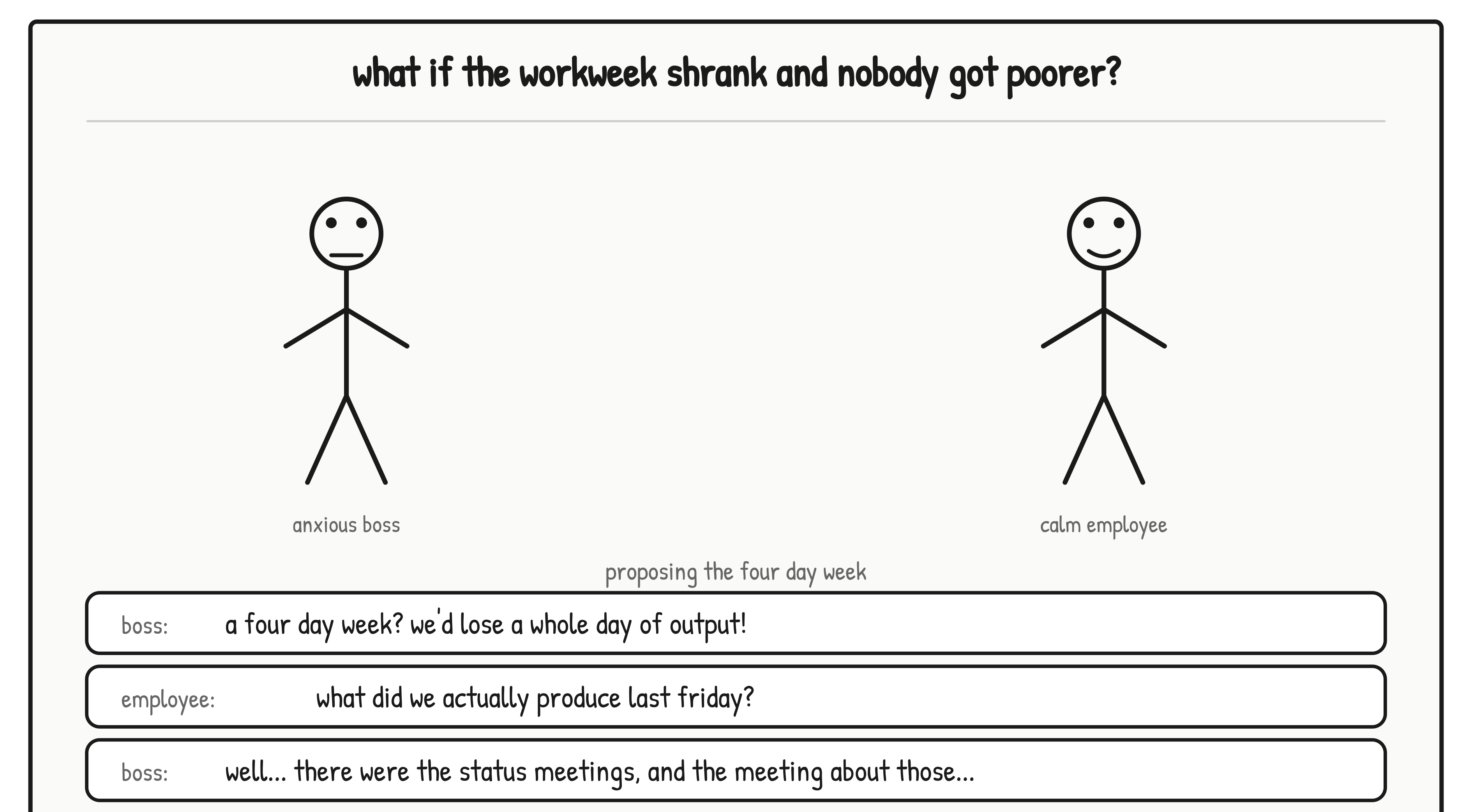
Maybe the deepest shift is not economic at all. It is the story we tell about what a life is for. We have spent a century quietly assuming that work is the center and life is what happens in the gaps around it. A shorter week gently reverses that. Work becomes a thing you do in order to have a life, rather than a life you fit around the work.
That reversal sounds small written down. Lived out across a whole society, it is enormous. It is the difference between a population that endures its weeks and one that actually inhabits its days. The week was invented once, by people with far less wealth and far worse tools than we have now. There is no reason we cannot invent it again, and every reason to think the next version could be kinder than the last.

 What if in the Future
Leave a comment