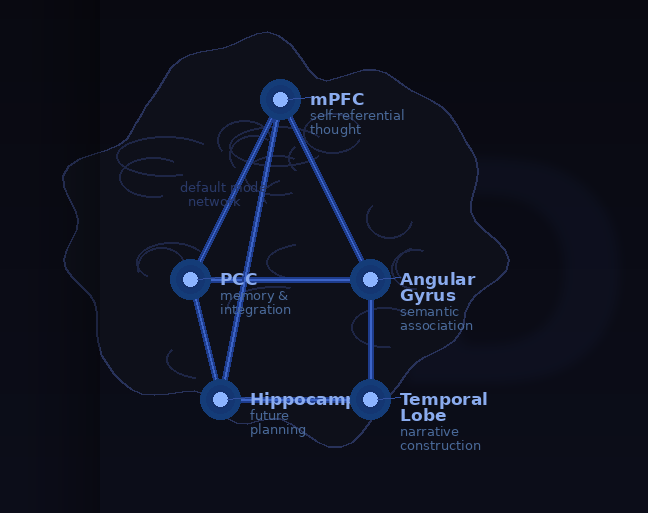
There is a part of your brain that only activates when nothing is happening. Neuroscientists call it the default mode network. It switches on during rest, during daydreaming, during the unfocused wandering that happens when you stare out a window with nowhere to be. For decades after its discovery, researchers assumed it was housekeeping: the brain idling between tasks.
They were spectacularly wrong. The default mode network is where some of the most generative cognitive work in human experience takes place. Spontaneous, associative leaps that produce creative insight. Memory consolidation. Future planning. The research is unambiguous: the brain is not resting when it wanders. It is working on the hardest problems, in the only way they can be worked on: obliquely, without pressure, in the absence of demand.
There is a word for the condition that reliably activates it.That word is boredom. And we have spent the last twenty years building an extraordinarily sophisticated global infrastructure to eliminate it.
The Extinction of Empty Time
The five largest attention platforms generated over four hundred billion dollars in revenue in 2024. Every dollar came from a single source: the conversion of human idle time into monetizable engagement. The product was not content. It was the gap between one moment of stimulation and the next, captured and filled before it could develop into anything as economically unproductive as a thought.
What if The most valuable cognitive state in the world is the one we have engineered out of existence?
The scroll is not a neutral interface design. It is an infinite surface engineered so that the moment your attention loosens its grip on one stimulus, the next arrives. Each mechanism individually trivial. Together forming the most effective attention capture system ever built, one that has produced what one longitudinal study described as a thirty-seven percent erosion of sustained focus since the year 2000.
We are not distracted. We are being distracted, continuously, at industrial scale, by systems whose business model depends on preventing the cognitive state that makes us most fully human.
What the Right Would Actually Protect
Boredom is not an absence. It is a transitional state: the bridge between external demand and internal generation. Newton’s apple did not fall during a brainstorming session. It fell during the kind of afternoon that no contemporary knowledge worker is ever allowed to have.
The right to boredom is not about nostalgia for a pre-digital world. It is about recognizing that the architecture of the attention economy was not designed with human cognitive welfare in mind and does not have to stay that way. The defaults that govern how we spend our mental lives were set by engineers optimizing for engagement metrics. Those defaults can be reset.
A civilization that took this seriously would protect the cognitive infrastructure on which everything else depends. Democratic deliberation does not happen in a feed. It happens in the cognitive space where people have time to hold complexity, to sit with arguments that do not resolve quickly, to form considered opinions rather than performed reactions. A polity of permanently distracted minds is not a democracy in any meaningful sense.
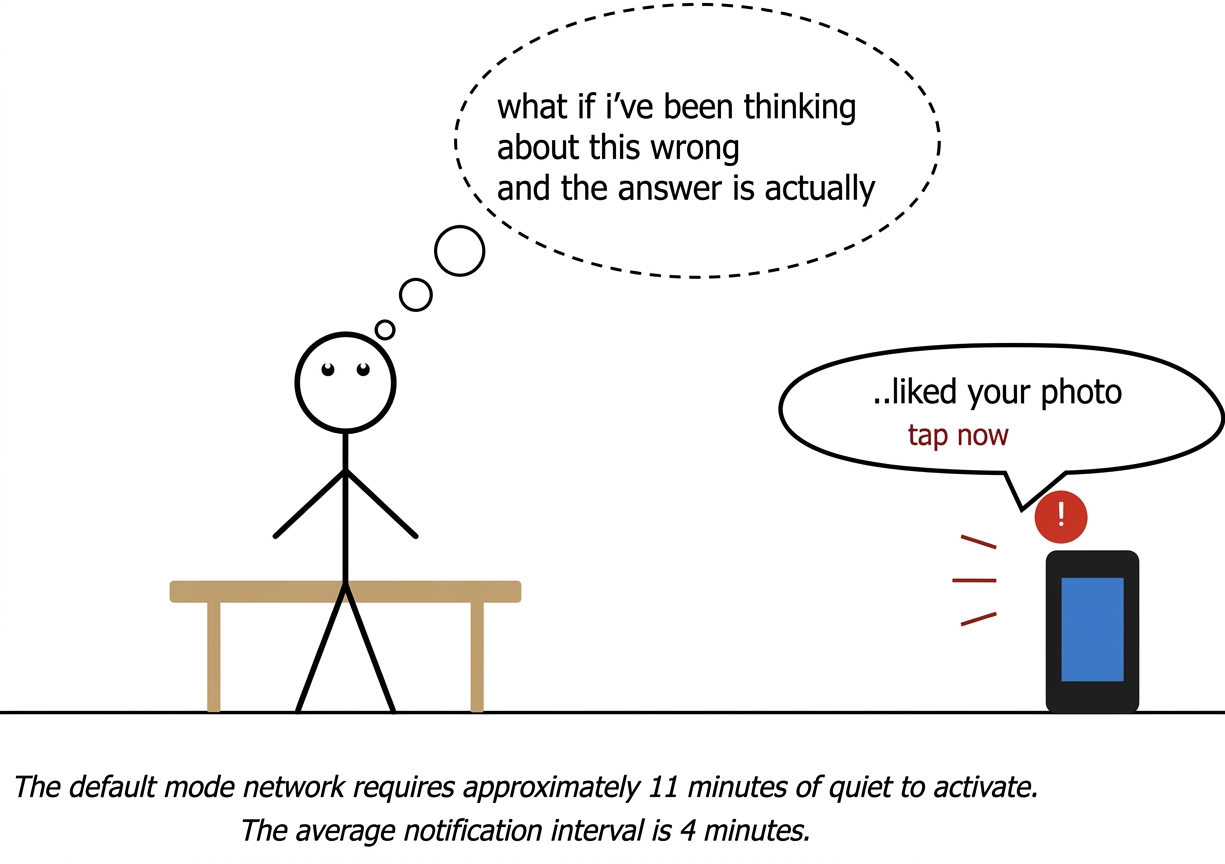
The argument, developed by a growing cohort of legal scholars, is that mental autonomy is a foundational right from which all other rights depend. You cannot exercise freedom of thought if your thought is continuously captured. Cognitive liberty is not a luxury. It is the substrate on which every other liberty rests. Newton’s apple is still falling somewhere. The question is whether we have engineered away the afternoon in which someone might have been watching.
 What if in the Future
Leave a comment