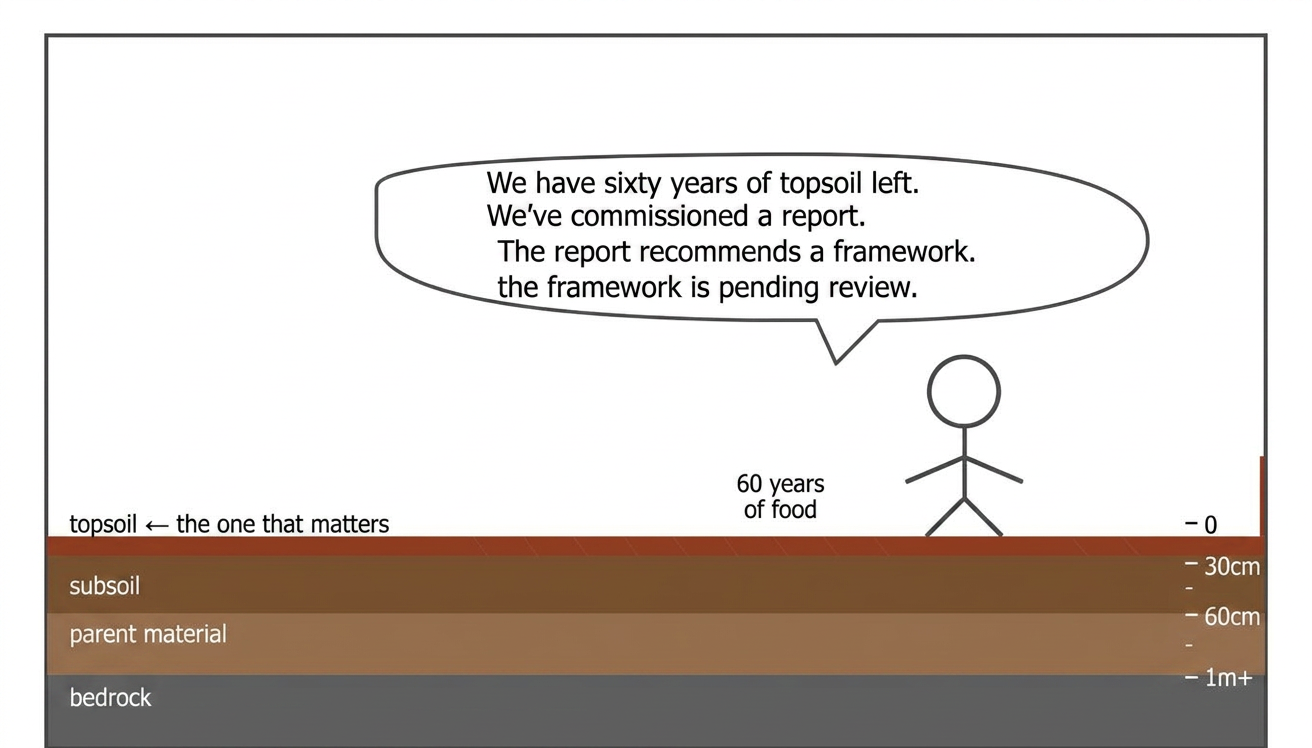
The world loses approximately twenty-four billion tonnes of fertile topsoil every year. At current rates of degradation, the United Nations Food and Agriculture Organization has estimated that the world has roughly sixty years of topsoil remaining for agriculture. The number is disputed, the methodology contested, and the timeline uncertain. The direction is not.
Topsoil is the thin biological layer, rarely more than a meter deep and often far less, in which almost all terrestrial food production occurs. It took approximately a thousand years to form each inch of it. Industrial agriculture, which depends on deep tilling, chemical inputs that degrade microbial life, and the removal of the ground cover that protects topsoil from erosion, has been depleting it at rates orders of magnitude faster than it forms.
We talk about peak oil. We have not developed an equivalent vocabulary for peak soil, despite the fact that no energy source can substitute for the biological substrate that food grows in.
The Invisible Infrastructure
Soil is infrastructure in the most fundamental sense: it is the physical foundation on which all terrestrial food production rests. But it is infrastructure that is almost entirely absent from the policy frameworks and accounting systems that govern how we manage land.
Oil reserves are tracked, reported, traded, and regulated. Soil health is monitored in some research contexts and ignored in most commercial and policy ones. Agricultural subsidies in most wealthy countries incentivize the practices that deplete soil fastest: monoculture, heavy tilling, intensive chemical inputs, the prioritization of short-term yield over long-term fertility.
The incentive structure works backward. The farmer who depletes their soil and maximizes yield today is rewarded by the market. The farmer who invests in soil health, rotates crops, plants cover crops, reduces tillage, and accepts lower short-term yields is penalized by the same market. The externalized cost, the degradation of the soil that future farmers and future food systems will depend on, appears nowhere in the accounting.
The Carbon Connection
There is a remarkable convergence that climate policy has mostly failed to exploit. Healthy soil is one of the most significant carbon sinks on Earth. Degraded soil releases carbon. Industrial agriculture practices that deplete topsoil are simultaneously degrading our food security and accelerating climate change. The regenerative agriculture practices that rebuild soil health are simultaneously sequestering carbon. The same set of agricultural choices that determines the long-term fertility of farmland also determines whether agriculture is a net source or net sink of greenhouse gases.
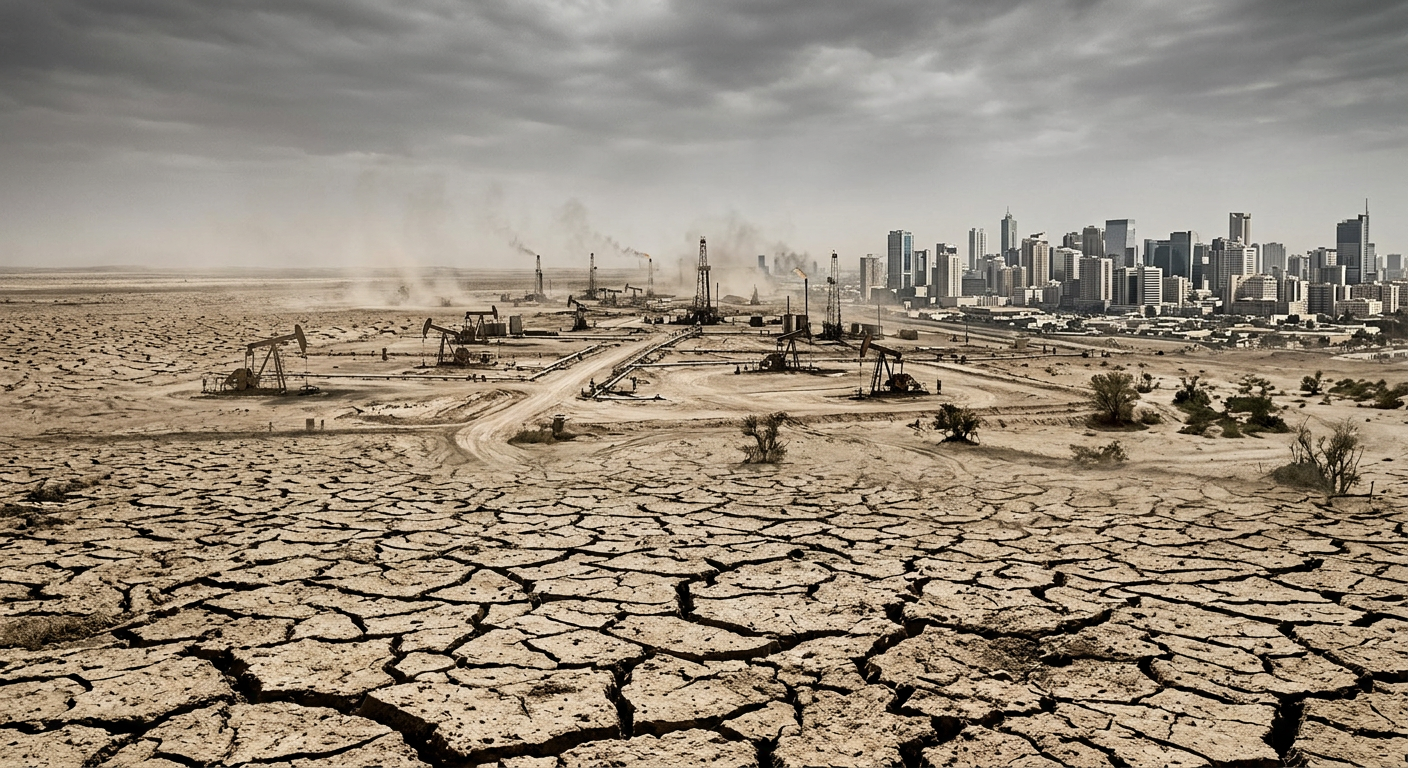
This convergence should make soil health central to climate policy. Instead, the two conversations are largely conducted in separate rooms, by separate agencies, using separate metrics, with separate subsidy systems that often work at cross purposes.
The carbon credit markets that have been developed to incentivize carbon sequestration in agriculture are a beginning. They are also, in their current form, largely disconnected from soil health measurement, easily gamed, and governed by methodologies that bear little relationship to the actual biological processes they claim to quantify.
The Sixty-Year Horizon
The timeline of sixty years of remaining topsoil is, if even approximately correct, one of the most consequential figures in contemporary environmental assessment. It is also one of the least discussed outside specialist agricultural science.
The reason it does not generate the political urgency that equivalent climate projections do is partly about visibility: you cannot photograph a soil microbial community dying the way you can photograph a glacier retreating. It is partly about timescale: sixty years is beyond the planning horizon of most political systems. And it is partly about the same structural problem that governs every slow-moving environmental crisis: the costs will be borne by people who have no vote in the decisions that are creating them.
The oil ran out in projections many times before those projections were proven wrong by new discoveries and new technologies. The same may be true of soil. But the mechanisms for discovering new soil, or for substituting something else for the biological substrate that food grows in, are considerably less clear than the mechanisms for finding new oil.
The soil under your feet is the product of a thousand years of biological work. What we do with the next sixty is a choice we are making right now, largely without noticing that we are making it.

 What if in the Future
Leave a comment